



When Diana McKenzie enrolled two of her offshore team members in the VAP Training Academy's Credit Analyst Program, the goal wasn't to change their roles overnight.
The goal was to continue developing their skills while supporting the growing demands of the business. At the time, both team members were primarily focused on loan processing.
Like many support team members balancing additional training with a full workload, their initial reaction was understandable.
"It felt like another thing on top of what they were doing."
The business was busy, settlement volumes were increasing, and most of the team's attention remained focused on processing loan applications, supporting clients, and keeping files moving through the workflow. Then Diana began noticing changes in the quality of the work coming back to her.

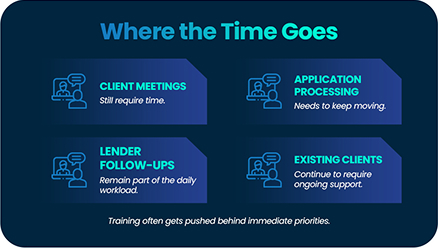
Why Training Mortgage Support Team Members Is Difficult
Many brokers understand the value of developing their people.
The challenge is creating enough time to do it consistently.
In many mortgage businesses, support team members often learn through observation.
They learn by watching files being prepared, sitting in on conversations, and asking questions as situations arise. That approach can work, but development often depends on what files happen to come across their desk and what learning opportunities become available.
Some team members gain exposure to more complex lending scenarios. Others spend months focused on administration and processing work. For Diana, the Academy provided structured learning alongside the practical experience already happening inside the business.
Rather than relying solely on day-to-day exposure, her team could work through specific concepts and then apply them to real files.
The First Signs of Growth
Diana wasn't expecting her team members to immediately move into dedicated credit analyst roles. What she noticed first was an improvement in the work they were already doing.
As they worked through the program, the training in areas such as reading payslips, servicing calculators, and application analysis began showing through in their attention to detail and the way they approached applications.
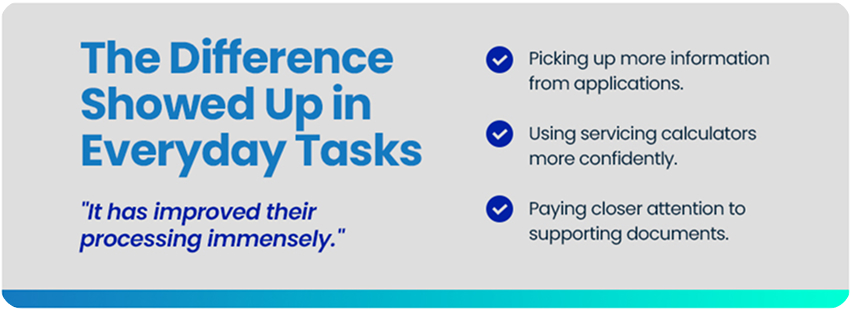
While they weren't yet responsible for recommending lending solutions, they were starting to analyse information more thoroughly before files reached Diana's desk.
As Diana explained:
"They're thinking like a credit analyst."
What's the Difference Between a Loan Processor and a Credit Analyst?
One of the most interesting parts of Diana's feedback was the distinction between processing a file and analysing a file. In many mortgage businesses, support team members begin by learning loan processing.
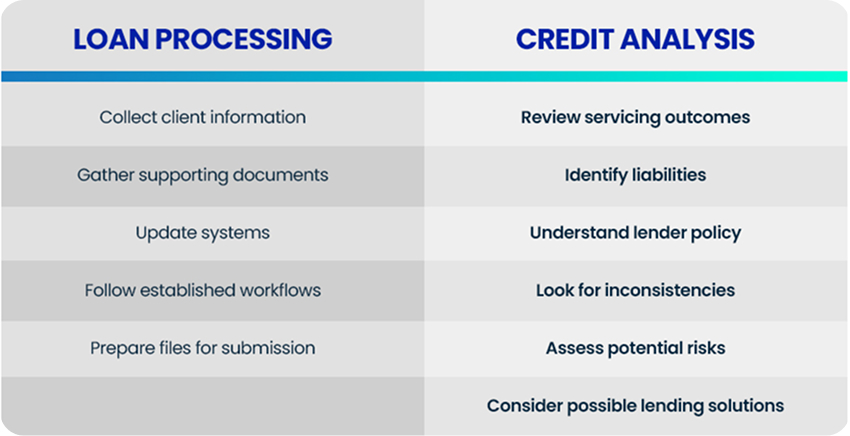
A credit analyst reviews information and assesses what it means. Within Diana's team, that shift became increasingly evident. Instead of simply completing tasks, her team members were increasingly looking at the information behind those tasks.
They were analysing applications while processing them.
That change was reflected in the notes they provided, the questions they asked, and the information they highlighted before files reached her for review.
Applying What They Learned To Real Files
One reason the training worked well for Diana's team was that the concepts could be applied immediately. The learning wasn't disconnected from their day-to-day responsibilities. They could use it on real applications.
They also became familiar with tools used across the mortgage industry. The team used Quickly to access lender credit policies and compare lender policy requirements.
They were also introduced to Scenario, which helped them review lender policy information and lending scenarios more efficiently.
Rather than bringing every question back to the broker, they were developing the ability to research information and provide more informed observations on files.

Why Capability Develops in Stages
One of Diana's strongest observations was that capability develops over time. Her approach has always been to build responsibility gradually.
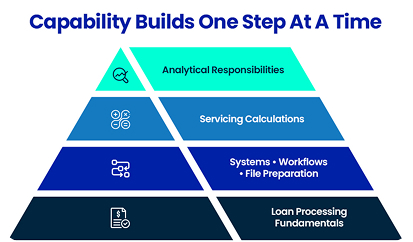
That was the approach she used with both team members.
Rather than trying to teach everything at once, capability was developed progressively as experience grew.
For mortgage businesses looking to develop future credit analysts, that progression can be easier to manage than expecting new team members to learn processing and analysis simultaneously.
Why They Wanted More Responsibility
One of the more interesting observations Diana shared was that both team members actively wanted more responsibility.
She described them as people who were always looking for opportunities to challenge themselves.
As their skills developed, they became increasingly involved in more complex parts of the lending process.
They wanted greater exposure to the lending process and opportunities to apply what they were learning through the program.
According to Diana, that willingness to learn has been a consistent part of their development.
Building Towards End-to-End Ownership
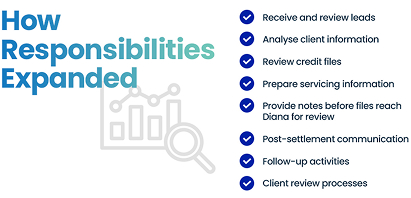
Over the last twelve months, Diana has gradually expanded the responsibilities of both team members.
Many of these responsibilities were not part of their role when they first started. Diana's goal is for both team members to eventually manage their own files through most of the lending process.
She described the current structure as a work in progress, with responsibilities continuing to expand as capability develops.
While Diana still manages lender discussions, strategic recommendations, and final lodgements, much of the preparation work is now handled by the team.
The Business Impact
Developing capability is important. For business owners, the real question is whether that capability creates measurable value.
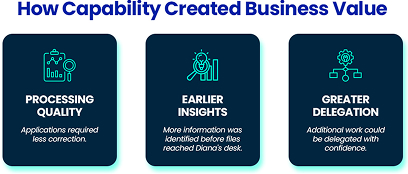
For Diana, the impact became visible through the quality of work being completed and the amount of responsibility her team could take on.
The investment also made sense financially. The program delivered approximately 20 to 23 hours of structured training. Diana compared that against the time she would otherwise spend mentoring and teaching those skills herself.
She explained that her mentoring and consulting work is typically valued at around $150 per hour. The business outcomes were also noticeable.
Diana explained that the additional settlements generated by the business needed to cover the cost of the team. Her benchmark was approximately an additional $1 million in settlements per month. The business exceeded that figure.
"We're easily settling more than a million a month compared to what we were before."
"We're probably settling three million extra a month."
Diana attributes that growth to a combination of factors, including stronger systems, increased delegation, and a team capable of taking on more responsibility as the business expanded.
Why Diana Recommends the Program
When asked whether she would recommend the program to other brokers, Diana didn't hesitate.
"If someone said to me, should I pay for my girls to do it? I would say absolutely."
That recommendation came from her experience watching the development of her team. That recommendation came from seeing improvements in processing quality, greater delegation, and the value of structured learning alongside day-to-day work.
Without that structure, much of the development would have relied on her finding additional time to train and mentor her team personally. For busy brokers, that can be difficult. The Academy provided another avenue for capability development while the business continued operating at full pace.
A Safe Place to Learn
One part of Diana's feedback stood out more than anything else. It wasn't about settlements. It wasn't about revenue. It was about how people learn. Diana believes team members improve fastest when they aren't afraid of getting something wrong.
"If you get it wrong, it doesn't matter."
"I'm going to show you so next time."
"There is never any shame."
Rather than treating mistakes as failures, Diana encourages her team to ask questions, attempt new tasks, and learn through experience without feeling embarrassed about getting something wrong.
She believes that approach has encouraged both team members to continue taking on more responsibility and developing new skills over time.
Investing in the Team You Already Have
Capability doesn't develop all at once. For Diana, it came from giving her team the opportunity to learn, apply what they learned, and gradually take on more responsibility.
Today they're contributing in ways that weren't possible when they first started. That has helped Diana delegate with greater confidence while continuing to support a growing business.
And for Diana, the next stage of that journey has already begun.

Every team's development journey looks different.
Diana's story reflects one business's experience with structured learning, practical application, and gradual capability development.

.jpg)
.webp)