

Atomic Answer:
DIY offshore hiring can offer more direct control and a lower visible hiring cost, but it also leaves recruitment, employment administration, onboarding, IT, security and performance management with your business. A managed provider costs more upfront because those functions are included. The right model depends on the infrastructure and management responsibility you are prepared to take on.
Once you have decided offshore staffing could work for your business, another decision quickly follows: do you hire and manage someone directly, or work with a managed offshore staffing provider?
For mortgage brokers and financial planners comparing an offshore staffing agency vs DIY hiring in Australia, cost is often where the discussion starts.
Hiring directly can look cheaper. You find the employee, agree on remuneration and manage the relationship yourself. There is no provider fee sitting between the business and the team member.
But salary is only one part of employing and supporting someone offshore.
Recruitment, HR administration, equipment, technology, security, training, management time and replacement risk still exist. With DIY hiring, your business becomes responsible for arranging them.
That makes the real comparison less about salary versus provider fee and more about what your business needs to build and manage under each model.
What is DIY offshore hiring?
DIY offshore hiring means your business takes responsibility for sourcing, engaging and managing an offshore worker without a managed staffing provider handling the employment and operational infrastructure around that person.
There are different ways to structure it.
You might find a candidate through an online platform, use a recruiter to source someone and then manage them yourself, or establish a direct employment arrangement overseas.
The appeal is understandable.
If you want to hire offshore VA directly in Australia, you may see a lower headline cost and have complete control over who you hire, how you onboard them and how you structure the role.
For businesses that already have offshore employment infrastructure, experienced managers and established security processes, that flexibility can be valuable.
The challenge is what happens after recruitment.
Someone still needs to manage payroll and employment administration. Equipment and secure access need to be arranged. Processes need to be documented. Training and performance need to be managed. Someone needs to deal with absence, employee concerns, technology issues and eventual replacement.
DIY removes the provider. It does not remove the work surrounding the employee.
For a financial planning practice or mortgage brokerage handling client and financial information, that distinction deserves particular attention.
What are the real costs of managing offshore staff yourself?
The easiest mistake in an agency vs direct offshore staff comparison is putting monthly salary beside the managed-provider fee and treating the difference as savings.
They are not equivalent cost bases.
A direct employee's salary is one component. Depending on how the arrangement is structured and where the worker is employed, your total operating model may also need to account for recruitment, payroll and employment administration, statutory employment obligations, benefits, hardware, software, internet, IT support, HR and management.
Then there is internal time.
A manager spending three hours each week supporting one offshore employee is committing more than 150 hours a year. At five hours a week, that becomes around 260 hours. These are illustrative calculations, rather than VAP performance benchmarks, but they show why management time belongs in the cost comparison.
This is where The True Cost of Offshore Staffing for Mortgage Brokers becomes useful. It breaks offshore costs beyond the monthly salary into the broader employment and operational expenses that should be considered.
The same principle applies when comparing providers. Download The Ultimate Guide to Hiring Onshore vs. Offshore: Salary, Benefits & Operations Breakdown to compare salary, employment costs, benefits and operational considerations across different staffing models.
Here is a more useful comparison:
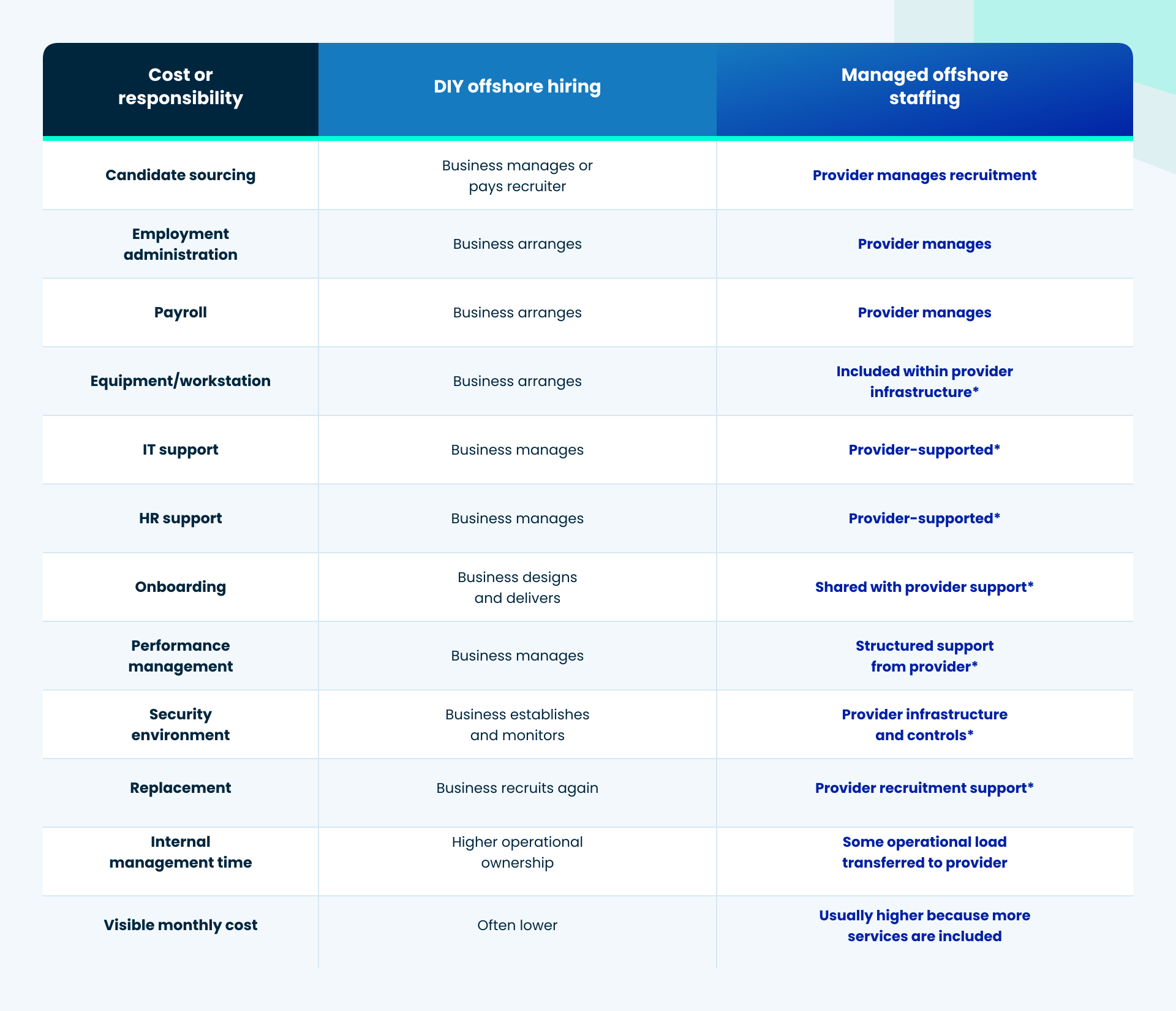
*Inclusions vary between providers. These references describe VAP's managed staffing model and should not be assumed to apply to every offshore staffing provider.
The right question is therefore not simply, “Which monthly fee is lower?”
It is: “What will this staffing model require our business to manage?”
What does a managed provider handle that you don't have to?
Managed offshore staffing puts infrastructure around the person you hire.
With VAP's model, this includes role-based recruitment, employment and HR support, IT and secure office infrastructure, onboarding support, Client Success management and ongoing employee development.
Your business still manages the work.
You decide what the team member does, establish priorities, provide business-specific training and remain responsible for the relationship between the role and your Australian operation.
The difference is that you are not building every supporting function yourself.
Consider recruitment.
Hiring directly means advertising, screening, interviewing, checking candidate suitability and restarting the process if the person leaves.
A managed provider already has recruitment infrastructure designed around offshore hiring.
Then consider employee support.
When someone has an HR question, equipment issue or workplace concern, your Australian manager does not necessarily need to become the first point of contact for every operational matter.
That distinction becomes more important as you grow from one offshore employee to several.
Managing one person directly may feel straightforward. Managing five means five sets of equipment, employment administration, performance conversations, access requirements and continuity risks.
A managed model gives businesses infrastructure that can expand with the offshore team.
You can learn more about the operating structure behind this model on the About VAP page.
Risk comparison: compliance, data, performance
The offshore hiring risks Australian businesses need to consider extend beyond whether someone can perform the job.
For financial services businesses, three areas deserve particular attention.
Compliance
Using offshore staff does not transfer your Australian regulatory responsibilities to the worker or staffing provider.
Mortgage brokers and financial planning practices still need to determine which activities can appropriately be delegated, what supervision is required and which responsibilities must remain with appropriately authorised people.
A managed provider can provide infrastructure and controls around the offshore workplace, but it does not replace your own compliance obligations.
Data and privacy
Where an Australian Privacy Principle entity discloses personal information to an overseas recipient, APP 8 can require reasonable steps to ensure that recipient does not breach the APPs. In certain circumstances, the Australian entity can also remain accountable for how that information is handled overseas.
This makes questions about system access, work environments, device controls, information-security processes and employee awareness important regardless of the hiring model.
DIY means your business needs to assess and establish the appropriate controls itself.
VAP operates its managed model with secure office infrastructure and an ISO/IEC 27001 information-security framework. That provides an established environment, although each Australian business must still assess its own obligations and configuration.
Performance
A poor hire is expensive under either model.
With DIY, however, your team normally owns the complete response: performance management, documentation, additional training and, if necessary, recruitment of a replacement.
A managed arrangement provides another support layer around those processes.
That does not guarantee performance. It reduces the amount of infrastructure the Australian business needs to build independently.
When DIY makes sense (and when it doesn't)
DIY hiring is not automatically the wrong choice.
It can make sense when your organisation already has the resources to operate internationally.
For example, you may already have an overseas entity, local HR capability, established payroll processes, experienced offshore managers, documented security controls and a recruitment team that understands the local talent market.
In that situation, paying another organisation to provide infrastructure you already have may offer limited value.
Direct hiring can also suit businesses that deliberately want complete operational control and are prepared to accept the additional responsibility that comes with it.
The equation changes for a smaller mortgage brokerage or advice practice.
If a business is hiring offshore precisely because its local team has a capacity problem, asking that same team to become recruiter, HR support, IT coordinator and offshore operations manager can work against the original objective.
The lower visible cost can come with a higher internal workload.
Before deciding, ask:
- Who will recruit and screen candidates?
- Who understands local employment requirements?
- Who provides equipment and technical support?
- Who manages employee concerns?
- Who monitors performance?
- Who establishes security controls?
- Who manages replacement if the employee leaves?
- How much Australian management time will those responsibilities require?
If you have confident answers and existing resources for each, DIY deserves consideration.
If those questions reveal another operating function you would need to build, compare the total cost and workload before choosing on salary alone.
Why VAP clients choose managed over direct
The strongest case for managed staffing is not that every business should avoid direct hiring.
It is that many businesses want the benefits of a dedicated offshore team without having to establish an offshore employment and support operation themselves.
That distinction can become particularly valuable as teams scale.
Walker Lane, for example, expanded its offshore support structure from an initial setup into a six-person paraplanning function. The result was a substantial increase in SOA production capacity without relying solely on additional local recruitment.
NOW Finance took the model further.
Its offshore capability became part of the company's broader operating structure rather than a collection of isolated support roles. As that model matured, NOW Finance reported higher revenue per employee and a cost-to-income ratio reduced by a factor of three.
Those results should not be treated as guaranteed outcomes for another business. They show what can become possible when offshore staffing is integrated into a wider operating model rather than evaluated only as a cheaper labour source.
That is ultimately the distinction behind the offshore staffing agency vs DIY hiring Australia decision.
DIY gives you more responsibility and potentially a lower visible starting cost.
Managed staffing adds a service cost, but it also puts recruitment, employment support, infrastructure, employee development and operational support around the person joining your business.
The better option depends on which responsibilities you actually want to own.
Ready to Compare Your Options?
If you're weighing direct offshore hiring against a managed staffing provider, understanding the costs and responsibilities involved in each model can help you make a more informed decision.
Compare your staffing options
Download The Ultimate Guide to Hiring Onshore vs. Offshore: Salary, Benefits & Operations Breakdown to compare salary, employee benefits, employment costs and operational considerations across different staffing models.
Speak to a VAP Industry Expert
Want to understand how managed offshore staffing could work for your business? Speak with a VAP industry expert about your staffing needs, the responsibilities you want to delegate, and the level of support that could suit your business.
.webp)
.webp)