


To onboard an offshore VA into an Australian mortgage brokerage, define the role before day one, document repeatable workflows, establish secure system access, structure the first week around guided task exposure, and set clear performance expectations. Effective onboarding gives the offshore team member enough context, supervision and feedback to gradually take ownership of delegated responsibilities.
Hiring the right person is only the beginning. The first few weeks determine how quickly that person understands your brokerage, where their responsibilities begin and end, and how confidently they can contribute.
For brokers searching how to onboard offshore VA mortgage broker Australia, the most important principle is to treat onboarding as an operational process rather than a one-day introduction.
Even an experienced offshore loan processor will not automatically know how your brokerage works. They need to understand your preferred lenders, CRM, file structure, communication standards, escalation points and expectations around quality.
The objective is straightforward: give your offshore team member enough structure to learn the role without expecting them to absorb your entire business at once.
Here is a practical way to do it.
Step 1 — Map the roles and tasks before day one
Do not wait until your offshore team member starts to decide what they will do.
Before day one, create a clear list of responsibilities and separate them into three categories:
1. Tasks they can begin learning immediately
These should be repeatable, lower-complexity responsibilities with clear processes.
Examples might include:
- CRM updates and data entry
- Document collection and organisation
- Client follow-ups using approved processes
- File preparation
- Lender follow-ups
- Valuation administration
- Application status updates
- Settlement administration
2. Tasks they can progress towards
These are responsibilities that require greater familiarity with your brokerage, systems or mortgage workflows before ownership is transferred.
For an experienced or developing mortgage support professional, this could include more complex loan processing or credit support responsibilities where appropriate.
3. Tasks that remain with the broker or appropriately authorised person
Keep clear boundaries around activities involving regulated credit assistance, recommendations, lending decisions or professional judgement.
Your role map should also answer four questions for every delegated responsibility:
Who owns it?
When does it happen?
What does good completion look like?
When should it be escalated?
This prevents one of the most common onboarding problems: the offshore team member knows what task to perform but does not know when to ask for help.
If you are still determining which responsibilities belong in the role, What Tasks Can You Outsource as an Australian Mortgage Broker? provides a practical breakdown of responsibilities that can commonly be delegated.
What Tasks Can You Outsource as an Australian Mortgage Broker? A Complete Delegation Guide
The goal before day one is not to create the biggest possible role. It is to create a role someone can understand.
Step 2 — Build your SOPs and process documentation
Once responsibilities are mapped, document how the recurring work gets done.
An effective SOP for an offshore mortgage assistant does not need to be a 20-page manual. For many tasks, a short step-by-step document supported by screenshots, templates or a screen recording is more useful.
For each recurring process, document:
- Trigger: What starts the task?
- Inputs: What information or documents are needed?
- Process: What steps need to happen and in what order?
- Systems: Which platforms are used?
- Quality check: What needs to be checked before completion?
- Escalation: What situations need broker or manager input?
- Output: What does a completed task look like?
Take document collection as an example.
Instead of writing:
Follow up outstanding documents.
Your SOP should explain when the follow-up occurs, which communication template is used, where documents are saved, how the CRM is updated and what happens if the client does not respond.
That removes unnecessary interpretation.
Prioritise SOPs based on frequency. Start with the five or ten processes your new team member will encounter most often rather than trying to document the entire brokerage before they arrive.
Screen recordings can also help with system-based processes. A team member can see exactly how an experienced employee completes a task and refer back to the recording while learning.
Your SOP library should evolve. If the same question comes up repeatedly during onboarding, that is often a sign the documentation needs clarification.
Good documentation reduces reliance on memory and gives the team member somewhere to look before escalating routine questions.
Step 3 — Set up systems access securely
System access should be ready before the employee needs it, but that does not mean providing access to everything on day one.
Start with the principle of role-appropriate access.
List every platform the role requires, such as:
- CRM
- Email and communication platforms
- Document management systems
- Lender portals where appropriate
- Workflow or task-management software
- Internal knowledge bases
- Relevant mortgage processing systems
Then determine the level of access required for each.
Avoid sharing another employee's credentials. Create individual accounts wherever the platform allows it so activity and access can be managed appropriately.
Your pre-start checklist should include:
- User accounts created
- Permissions reviewed
- Multi-factor authentication configured where available
- Required software available
- Communication tools tested
- Document locations confirmed
- Password and access procedures explained
- Escalation process established for access problems
For mortgage brokerages, secure access is particularly important because team members may handle personal and financial information.
Using offshore staff does not remove the Australian business's privacy, security or regulatory responsibilities. Your brokerage still needs appropriate controls around what information people can access and how it is handled.
A managed staffing provider can support the work environment and technology surrounding the offshore employee, while the brokerage remains responsible for determining access to its own systems and client information.
Test the setup before day one. The first morning should not disappear into password resets and missing software.
Step 4 — Week 1 onboarding schedule
A structured first week gives your new team member context before expecting independent output.
A practical offshore staff onboarding mortgage broker schedule could look like this:
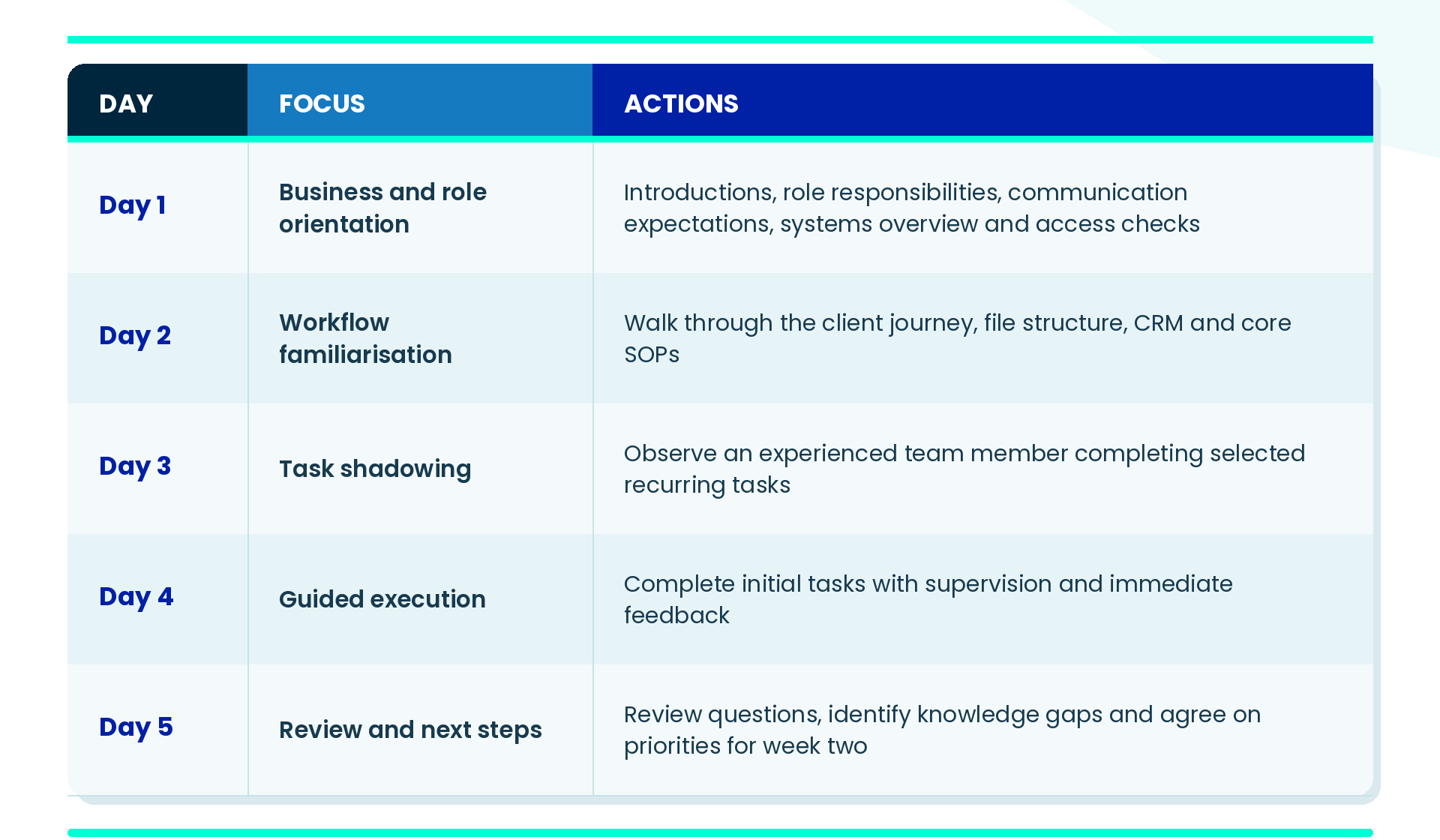
Day 1: Give them context
Explain how the brokerage operates before focusing on individual tasks.
Who are the key people? Who does the offshore team member report to? Who answers technical questions? What happens from initial enquiry through to settlement?
This context helps individual tasks make sense.
Days 2–3: Show the process
Walk through the SOPs and demonstrate the work.
Use real examples where appropriate and explain why certain checks exist rather than asking the person to memorise steps without context.
Encourage questions.
Days 4–5: Move from watching to doing
Select a small number of repeatable responsibilities and let the team member complete them under supervision.
Review the output promptly.
Avoid waiting until the end of the week to correct misunderstandings. Early feedback prevents an incorrect process from becoming a habit.
By the end of week one, the goal is not complete independence. It is clarity around the role, systems, first responsibilities and where to go for help.
Step 5 — KPIs and performance management
Knowing how to manage an offshore mortgage team starts with defining what good performance looks like.
Avoid measuring activity simply because it is easy to count.
A high number of completed tasks means little if files regularly need to be corrected.
Depending on the role, useful performance measures may include:
- Task accuracy
- Turnaround against agreed expectations
- File completeness
- CRM accuracy
- Follow-up completion
- Adherence to documented processes
- Appropriate escalation
- Responsiveness and communication
- Progress towards agreed capability goals
Set a baseline during onboarding rather than expecting full productivity immediately.
For the first month, use frequent check-ins. A short daily touchpoint during the initial learning period can surface questions quickly. As the employee becomes more confident, this can move towards a regular weekly review.
Performance conversations should cover more than mistakes.
Ask:
What is working well?
Where are you getting stuck?
Which processes remain unclear?
What are you ready to take ownership of next?
This creates a progression path rather than leaving the role static.
As capability develops, responsibilities can be expanded deliberately. That is particularly relevant for mortgage professionals progressing from administrative work towards more advanced loan processing or credit support.
Common onboarding mistakes to avoid
Most onboarding problems are not caused by distance. They come from unclear expectations.
Giving someone everything at once
A long task list is not an onboarding plan. Start with defined responsibilities and build progressively.
Assuming mortgage experience means they know your business
An experienced team member may understand Australian mortgage workflows while still needing to learn your processes, lenders, systems and service standards.
Relying entirely on verbal instructions
If important processes exist only in someone's head, the new employee will repeatedly need to ask the same questions.
Providing too much system access
Match access to the responsibilities the person actually performs and review permissions as the role develops.
No clear escalation point
The team member should know exactly when to stop and ask rather than making assumptions.
Waiting too long to provide feedback
Correct misunderstandings while the process is still being learned.
Expecting the provider to teach your internal business processes
A managed provider can support recruitment, employment, infrastructure and employee development. Your brokerage still owns its internal workflows, service expectations and business-specific training.
Treating onboarding as finished after week one
The first week establishes the foundation. Capability develops through continued exposure, feedback and responsibility.
If you are evaluating the broader operational investment involved in building your offshore team, The True Cost of Offshore Staffing for Mortgage Brokers explains the employment and support costs that sit beyond salary alone.
The True Cost of Offshore Staffing for Mortgage Brokers
How VAP manages onboarding for you
Working with a managed staffing provider changes which parts of onboarding your brokerage needs to build itself.
VAP supports the employment and operational environment around your dedicated offshore team member, including recruitment, HR support, IT, secure office infrastructure, Client Success support, performance support and ongoing capability development.
Your brokerage remains closely involved where it matters most: defining the role, teaching your internal processes, establishing priorities, supervising delegated work and maintaining responsibility for regulated activities.
That creates a shared onboarding model.
VAP supports the person and working environment. Your brokerage teaches the business.
For mortgage broking team members, capability development can also continue beyond initial onboarding. VAP's Training Academy – Credit Analysis Program provides eligible mortgage professionals with a pathway to strengthen their understanding of Australian mortgage workflows and develop more advanced credit capability.
The objective is progressive integration.
A new team member might initially work within a smaller set of documented responsibilities. As they demonstrate accuracy, understand your processes and develop capability, you can gradually broaden what they own.
That approach helps avoid the two extremes that commonly undermine offshore onboarding: giving someone too much responsibility too quickly or leaving a capable employee performing the same basic tasks indefinitely.
You can explore how VAP supports Australian mortgage brokers with dedicated offshore teams for more information about the roles, infrastructure and ongoing support available.
Ready to Onboard Your Offshore Team Member?
If you already know the role you want to build, the next step is turning that role into a practical onboarding plan.
Download the Onboarding Checklist
Use the Offshore Team Member Onboarding Checklist to prepare your role map, SOPs, system access, first-week schedule and performance expectations before your new team member starts.
→ Download the Onboarding Checklist
Build Your Mortgage Broking Team With VAP
Already preparing to hire? Speak with a VAP Mortgage Broking Expert about the role you need, the responsibilities you want to delegate and how VAP can support the setup and onboarding of your dedicated offshore team member.
→ Book a Meeting With a VAP Mortgage Broking Expert

.webp)