
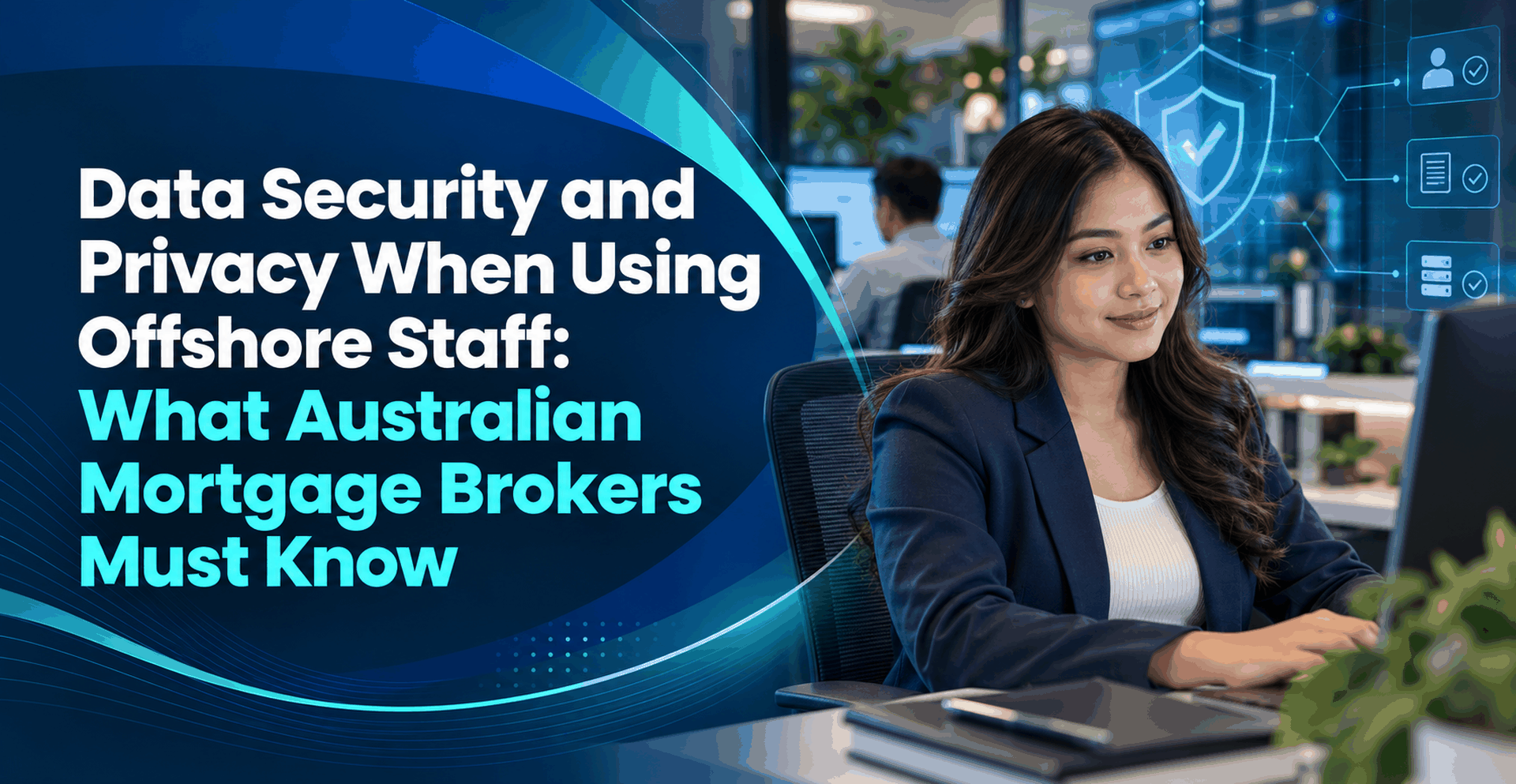

Data Security and Privacy for Offshore Mortgage and Financial Planning Teams
Offshore staffing can be used securely by Australian mortgage brokers when appropriate privacy, access, technology and governance controls are in place. VAP's ISO/IEC 27001-certified information security framework provides a structured approach to managing information security risk, while each Australian brokerage remains responsible for its own Privacy Act, licensing and regulatory obligations.
For a mortgage broker, the security question is rarely as simple as “Is the person offshore?”
The more useful questions are:
What client information can they access? From what environment? On which devices? How is that access controlled? What happens when something goes wrong?
That distinction matters because mortgage broking teams routinely work with identification documents, bank statements, employment information, credit histories and other personal and financial information.
The risks need to be managed accordingly.
VAP operates within an ISO/IEC 27001-certified information security framework, providing a structured approach to information security management. For mortgage brokers comparing offshore staffing models, that provides an important benchmark when evaluating how a provider manages security risk.
It does not, however, transfer the brokerage's regulatory responsibilities to the offshore provider.
That is why understanding data security for offshore staff in Australia is an important part of building an offshore mortgage broking team.
What are the Privacy Act obligations when using offshore staff?
The Privacy Act 1988 (Cth) and Australian Privacy Principles (APPs) remain relevant when an Australian mortgage brokerage uses offshore personnel to handle personal information.
Moving a function offshore does not remove the brokerage's privacy responsibilities. Brokers remain responsible for how client information is collected, accessed, stored, used and disclosed, regardless of where administrative support is located.
Two APPs are particularly relevant when considering offshore staff data privacy in Australia.
APP 8: Cross-border disclosure
APP 8 deals with cross-border disclosure of personal information.
Where an Australian Privacy Principle entity discloses personal information to an overseas recipient, it generally needs to take reasonable steps before disclosure to ensure that the overseas recipient does not breach the APPs in relation to that information, subject to exceptions.
This matters because giving an offshore provider or worker access to client information may constitute a disclosure depending on how the arrangement operates.
The practical question is therefore not simply whether your offshore team can access a system.
You need to understand what they can access, why they need it and what controls surround that access.
APP 11: Security of personal information
APP 11 requires an APP entity to take reasonable steps to protect personal information it holds from misuse, interference and loss, as well as unauthorised access, modification or disclosure.
For an offshore mortgage broking arrangement, those reasonable steps may extend across people, technology, systems and the physical working environment.
The VAP security white paper identifies controls including data classification and least-privilege access, encryption, managed devices, multi-factor authentication, restrictions on local storage and printing, and activity monitoring and logging.
For mortgage brokers, these controls sit alongside broader credit and governance obligations. Provider due diligence, system access, information security, contracts, monitoring and incident management should form part of the overall approach to managing an offshore team.
For a deeper mortgage-specific discussion of regulatory responsibilities, read Is Offshoring Compliant for Australian Mortgage Brokers? NCCP, Privacy and Aggregator Rules Explained.
What security standards should your offshore provider have?
Security should be assessed at the provider level, not assumed because someone works from an office or uses reputable software.
Before selecting an offshore provider, look at the controls surrounding the employee throughout the working day.
A useful assessment should cover:
- Governance: Are security responsibilities, policies and incident procedures documented?
- Physical security: Who can enter the work environment and reach devices or workstations?
- Access control: Does each employee receive access based on their role?
- Device security: Who owns and manages the computer used to access client information?
- Authentication: Is MFA used where supported?
- Data handling: Can files be downloaded, stored locally, copied or printed?
- Monitoring: Are access and activity capable of being logged and reviewed?
- Training: Do employees receive ongoing security awareness training?
- Incident management: What happens when a potential breach or security event occurs?
- Continuity: How does the provider maintain operations during disruption?
These questions help distinguish a structured offshore environment from an arrangement where security largely depends on an individual worker's home internet connection, personal equipment and habits.
For mortgage brokers, that distinction is particularly important when offshore team members may be accessing CRMs, document management systems, lender portals and client files containing sensitive personal and financial information.
The physical environment matters as well.
VAP's security framework highlights the importance of matching the sensitivity of the work to the controls surrounding the worker. Its guidance identifies secure-office measures including managed devices, MFA, endpoint protection, role-based access, audit logging, physical access controls and ongoing cyber training.
That makes the provider's security model part of your due diligence rather than an IT detail to investigate after hiring.
What is ISO 27001 and why does it matter?
ISO/IEC 27001 is an internationally recognised standard for an Information Security Management System, commonly referred to as an ISMS.
An ISMS provides a structured framework for identifying, assessing and managing information security risks.
For a mortgage brokerage considering ISO 27001 offshore staffing, the significance is straightforward: certification provides evidence that the provider has established a systematic approach to managing information security rather than relying only on individual security tools or informal procedures.
VAP operates under an ISO/IEC 27001-certified information security framework.
That matters because security is broader than installing antivirus software or asking employees to use strong passwords.
A mature security framework considers the interaction between:
People + Processes + Technology + Governance
For example, MFA is useful, but it does not solve inappropriate permissions.
A managed device is useful, but it does not replace employee security awareness.
A secure office helps control the physical environment, but the organisation still needs policies governing how client information is handled.
ISO/IEC 27001 brings information security risk into a management framework where controls can be assessed, maintained and improved.
There is an equally important limitation.
ISO/IEC 27001 certification does not make the Australian brokerage automatically compliant with the Privacy Act or NCCP Act.
Certification can provide additional confidence that security controls and governance processes are in place, while the brokerage retains its own compliance obligations.
That is the appropriate way to assess certification: as evidence supporting your provider due diligence, rather than a substitute for it.
How to audit your offshore provider's data practices
Before providing access to client information, ask your prospective offshore provider to demonstrate how its security model works.
Do not stop at:
“Are you secure?”
Ask questions that produce evidence.
1. Where will my team member work?
Establish whether work takes place in a controlled office, at home or through a hybrid arrangement.
Then ask what physical and technical controls apply in each environment.
2. What devices will they use?
Determine whether devices are company-managed or personal.
Ask how endpoint protection, software updates, patching and device policies are managed.
3. How is access controlled?
Look for role-based or least-privilege access.
A team member should have access to the information and systems required for their responsibilities rather than unrestricted access by default.
For a mortgage brokerage, that may mean considering access separately across the CRM, document management system, lender portals and other platforms used throughout the application process.
4. Can client information be stored locally?
Ask whether employees can download, copy, print or locally store client information.
VAP's security guidance recommends that offshore workers access information through secure cloud platforms and that local storage or printing should not occur unless specifically authorised under contract.
5. What security training does the team receive?
Security is also behavioural.
Phishing, weak password practices and mishandling information can undermine strong technical controls.
The VAP white paper advocates ongoing, role-specific awareness activity such as phishing simulations, password and data-handling training, breach scenarios and tracked compliance learning.
6. What happens when something goes wrong?
Ask about incident detection, escalation, reporting and response.
You should understand who is contacted, what records are maintained and how your brokerage would participate in managing an incident affecting client information.
7. Can the provider demonstrate its controls?
Request relevant certification and documentation rather than relying solely on marketing claims.
A provider should be able to explain how security works operationally.
VAP's Safe Solutions or Distant Dangers: Reclaiming Security in Offshore Operations provides further guidance for assessing offshore work environments, data security, governance and provider risk.
What does VAP's security framework include?
VAP's approach treats security as part of the offshore operating environment rather than leaving it entirely to the individual team member.
The VAP security framework covers areas including governance, secure work environments, people and behaviours, mandatory awareness training, technology, compliance documentation, and data security and operational resilience.
At the operational level, the framework identifies controls such as:
- Role-based and least-privilege access
- Company-managed or policy-compliant devices
- Endpoint protection and patching protocols
- Multi-factor authentication
- Secure cloud-based access
- Encryption for data in transit and at rest
- Controls around local storage and printing
- Monitoring, logging and audit trails
- Security awareness and behavioural training
- Incident response and resilience planning
These are the types of controls that matter when mortgage brokers compare offshore operating models.
VAP's ISO/IEC 27001 certification provides an additional layer of assurance around the information security management framework supporting those controls.
But the operating model still requires participation from the Australian brokerage.
Your brokerage determines which systems the offshore team member needs, what information is necessary for their responsibilities, what work they are permitted to perform and how that work is supervised.
Aggregator requirements should also be checked before offshore team members are introduced into workflows. VAP's existing mortgage compliance material notes that requirements can differ between aggregators, particularly where offshore personnel will access client management systems, lender portals or sensitive personal information.
The strongest security model therefore combines provider controls with brokerage-side governance.
That is also why the answer to “Is offshore staffing safe for Australian mortgage brokers?” is not a blanket yes or no.
It can be implemented securely when the environment, provider, access model, employee behaviour and the Australian brokerage's own governance are all addressed together.
Ready to Assess Your Offshore Security Approach?
If data security is one of the final considerations before building your offshore mortgage broking team, the next step is understanding the controls that should sit around your people, systems and client information.
Understand the Risks and Security Controls
Download Safe Solutions or Distant Dangers: Reclaiming Security in Offshore Operations for practical guidance on assessing offshore work environments, data security, governance and the controls that can help manage offshore risk.
→ Download the Offshore Compliance & Security Guide
Discuss Your Security Requirements With VAP
Have specific questions about client data, systems access or how an offshore team could operate within your brokerage?
Speak with a VAP Mortgage Broking Expert about your data security requirements, the roles you're considering offshore and the controls surrounding your proposed team.
→ Book a Meeting With a VAP Mortgage Broking Expert

.webp)
.webp)